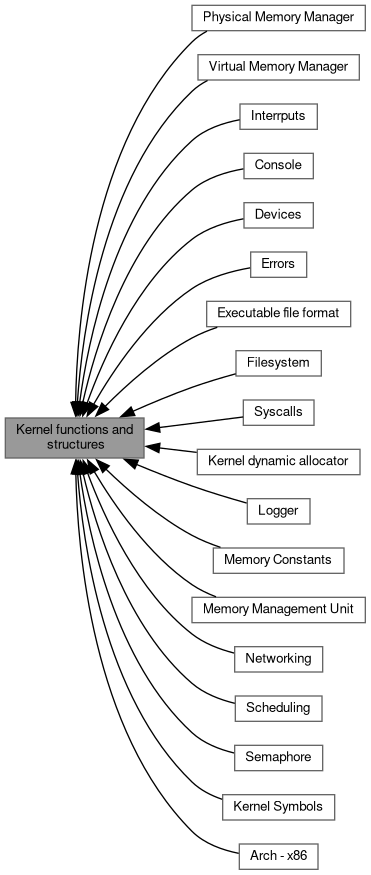
Modules | |
| Console | |
| Devices | |
| Kernel Device/Driver API. | |
| Errors | |
| Executable file format | |
| Interrputs | |
| Arch - x86 | |
| Kernel dynamic allocator | |
| Logger | |
| Memory Constants | |
| Memory Management Unit | |
| Networking | |
| Physical Memory Manager | |
| Scheduling | |
| Scheduler implementation. | |
| Semaphore | |
| Semaphore. | |
| Kernel Symbols | |
| Syscalls | |
| Filesystem | |
| Virtual Memory Manager | |
Data Structures | |
| struct | spinlock |
| Spinlock. More... | |
| struct | user_creds |
| User credentials. More... | |
Macros | |
| #define | __SPINLOCK_INIT |
| Default init value (unlocked) | |
| #define | __INIT_SPINLOCK(_lock) _lock = __SPINLOCK_INIT |
| Initialize a spinlock. | |
| #define | DECLARE_SPINLOCK(_lock) spinlock_t _lock = SPINLOCK_INIT |
| Declare a spinlock and initialize it. | |
| #define | locked_scope(_lock) |
| Define a scope that is guarded by a spinlock. More... | |
Functions | |
| static ALWAYS_INLINE spinlock_t * | __spinlock_acquire (spinlock_t *lock, vaddr_t owner) |
| Try to acquire a spinlock, or wait until it is free. | |
| static ALWAYS_INLINE void | spinlock_release (spinlock_t *lock) |
| Release a spinlock for others to take it. | |
| static ALWAYS_INLINE bool | spinlock_is_held (const spinlock_t *lock) |
| Check whether a lock is currently held by someone. | |
Variables | |
| uid_t | user_creds::ruid |
| uid_t | user_creds::rgid |
| uid_t | user_creds::euid |
| uid_t | user_creds::egid |
| uid_t | user_creds::suid |
| uid_t | user_creds::sgid |
Detailed Description
Kernel
This is a kernel (not micro nor monolithic yet), written from scratch on my free time to learn more about systems and OS designs.
Disclaimer
This kernel serves only one purpose: learning.
The implementations and design choices are likely to be ... questionable, but this is part of the process. There exists better sources of inspiration and better examples than this project.
Structure
I try to keep arcihtecture specific code and what can be generic separated. You can find the architecture depedent code (specific structures, devices, mechanisms ...) inside the kernel/arch folder.
Macro Definition Documentation
◆ locked_scope
| #define locked_scope | ( | _lock | ) |
This is particularily useful when taking and releasing a lock in a sequential manner. For example:
locked_scope(&list_lock) { llist_add(&global_list, &new_item); }
In this example the list_lock spinlock will automatically be taken when entering the scope, and also automatically released when leaving.
WARNING: As this macro uses a for loop to function, any 'break' directive placed inside it will break out of the guarded scope instead of that of its containing loop.
Variable Documentation
◆ egid
| uid_t user_creds::egid |
Effective GID
◆ euid
| uid_t user_creds::euid |
Effective UID
◆ rgid
| uid_t user_creds::rgid |
Real GID
◆ ruid
| uid_t user_creds::ruid |
Real UID
◆ sgid
| uid_t user_creds::sgid |
saved GID
◆ suid
| uid_t user_creds::suid |
saved UID