Scheduler implementation. More...
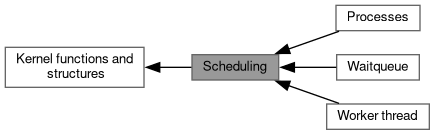
Modules | |
| Processes | |
| Waitqueue | |
| Waiting queue. | |
| Worker thread | |
| Worker thread. | |
Macros | |
| #define | no_preemption_scope() |
| Define a scope during which the current thread should never be pre-empted. More... | |
Functions | |
| void | schedule (void) |
| Reschedule the current thread. More... | |
| void | schedule_preempt (void) |
| Forcibly reschedule the current thread. | |
| bool | scheduler_preempt_disable (void) |
| Prevent the current thread from being pree-empted by the scheduler. More... | |
| void | scheduler_preempt_enable (bool old_if_flag) |
| Re-allow the current thread to be pre-empted. More... | |
| void | sched_new_thread (thread_t *) |
| Add a new thread to be scheduled. More... | |
| static ALWAYS_INLINE void | sched_new_thread_create (thread_entry_t entrypoint, void *data, u32 flags) |
| Create a new thread and instantly schedule it. More... | |
| void | sched_block_thread (struct thread *) |
| Mark the thread as blocked. More... | |
| void | sched_unblock_thread (thread_t *) |
| Unblock a currently blocked thread. More... | |
| void | sched_block_waiting_until (struct thread *, clock_t until) |
| Block thread and wait until a given deadline. | |
| void | sched_unblock_waiting_before (clock_t deadline) |
Unblock all waiting threads whose deadline is inferior to deadline. | |
Detailed Description
Scheduler
The scheduler is responsible for ... well, scheduling proceses.
It has to decide which threads to run next, and when, among all currently running threads. This is what allows running multiple threads on a single CPU.
A good scheduler is crucial to the user's experience, and this is often what makes the "feel" of the entire OS.
Design
For now, our scheduler uses a preemptive round-robin design. It holds a list of currently running threads, called the runqueue, and cycles between them at a regular interval.
The interval is set currently set to 2MS, per thread, per cycle, and is handled inside irq_timer_handler. If the current thread is still running when the current interval reaches its end, the next one takes its place, and the timer is reset. This is called preemption.
During the execution of a thread, it often needs to access some resources, thus having to wait until the resource is available. When this is the case, the thread is marked as SCHED_WAITING using sched_block_current_thread, and we switch to the next available running thread. Once the resource is available, the relevant interface has the resposibility to notify the scheduler that the thread can be rescheduled, using sched_unblock_thread.
Improvements
- Use a separate timer for pre-emption, instead of mingling with the one used for timekeeping. This would allow for dynamically resetting the timer interrupt without sacrificing precision on ticks.
- Priority levels. We would like to give more time to more "important" thread ideally. This would require multiple runqueues, but is a MUST have for any actual scheduler.
- SMP: when activating multiprocessing, we want to setup a scheduler per core, and dispatch threads across them. This would also imply other smart opimizations (time stealing, ...)
Macro Definition Documentation
◆ no_preemption_scope
| #define no_preemption_scope | ( | ) |
WARNING: As this macro uses a for loop to function, any 'break' directive placed inside it will break out of the guarded scope instead of that of its containing loop.
Function Documentation
◆ sched_block_thread()
| void sched_block_thread | ( | struct thread * | thread | ) |
A blocked thread cannot be rescheduled until it is explicitely unblocked using sched_unblock_thread()
◆ sched_new_thread()
| void sched_new_thread | ( | thread_t * | thread | ) |
When adding a new thread, its state will be set to SCHED_RUNNING
◆ sched_new_thread_create()
|
static |
- See also
- sched_new_thread thread_create
◆ sched_unblock_thread()
| void sched_unblock_thread | ( | thread_t * | thread | ) |
The thread is marked as SCHED_RUNNING and is automatically added to the appropriate runqueue.
◆ schedule()
| void schedule | ( | void | ) |
This is the main function of the scheduler. It is called when we want to switch to the next scheduled thread. It automatically reinserts the current thread into the correct queue depending on its state.
◆ scheduler_preempt_disable()
| bool scheduler_preempt_disable | ( | void | ) |
- Returns
- Wether interrupts were previously enabled
◆ scheduler_preempt_enable()
| void scheduler_preempt_enable | ( | bool | old_if_flag | ) |
- Parameters
-
old_if_flag The state of the interrputs prior to locking