Interrupts - x86 specific
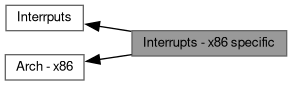
Collaboration diagram for Interrupts - x86 specific:
Data Structures | |
| struct | idtr |
| The location of the IDT is kept inside the IDTR (IDT register). More... | |
| struct | idt_descriptor |
| inside the IDT More... | |
| struct | interrupt_frame |
| Frame passed onto the interrupt handlers by our stub handler. More... | |
Enumerations | |
| enum | x86_exceptions |
| List of all x86 CPU exceptions Intel developper manual, Table 6-1. | |
| enum | idt_gate_type |
| The different types of interrupt gates Intel developper manual, section 6-11. | |
Variables | |
| u16 | idtr::size |
| Size of the IDT. | |
| u32 | idtr::offset |
| Linear address of the IDT | |
| u16 | idt_descriptor::offset_low |
| 16 lower bits of the handler function's address | |
| segment_selector | idt_descriptor::segment |
| Selector for the segment inside which we want to run the handler. | |
| u8 | idt_descriptor::access |
| Acess restriction flags for this interrupt | |
| u16 | idt_descriptor::offset_high |
| 16 higher bits of the handler function's address | |
| struct x86_regs | interrupt_frame::regs |
| Snapshot of the registers at the time the interrupt happened. | |
| u32 | interrupt_frame::nr |
| Error code and interrupt number (pushed by our stub) | |
Detailed Description
x86 specific interrupt interface implentation
Design
On x86 the interrupts are set-up using an Interrupt Descriptor Table.
This table can be located anywhere in memory and is pointed to by the address inside the IDTR register. It contains a pointer to each interrupt's specific handler, as well as information about how we want to run the interrupt (should never change).
Despite that, for conviniency, we define a common stub handler for each known CPU interrupts, which pushes additional information about the interrupt, and eventually calls the actual handler (if we defined one). The actual interrupts are software defined, located inside a static array and can be modified at will using interrupts_set_handler..
This lets us have more control on how we handle the interrupts.
- See also
- Intel developper manual, section 6
- OsDev - IDT