Process management. More...
#include <kernel/file.h>#include <kernel/types.h>#include <kernel/user.h>#include <kernel/vmm.h>#include <kernel/signal.h>#include <libalgo/linked_list.h>#include <utils/compiler.h>#include <string.h>#include <kernel/arch/i686/process.h>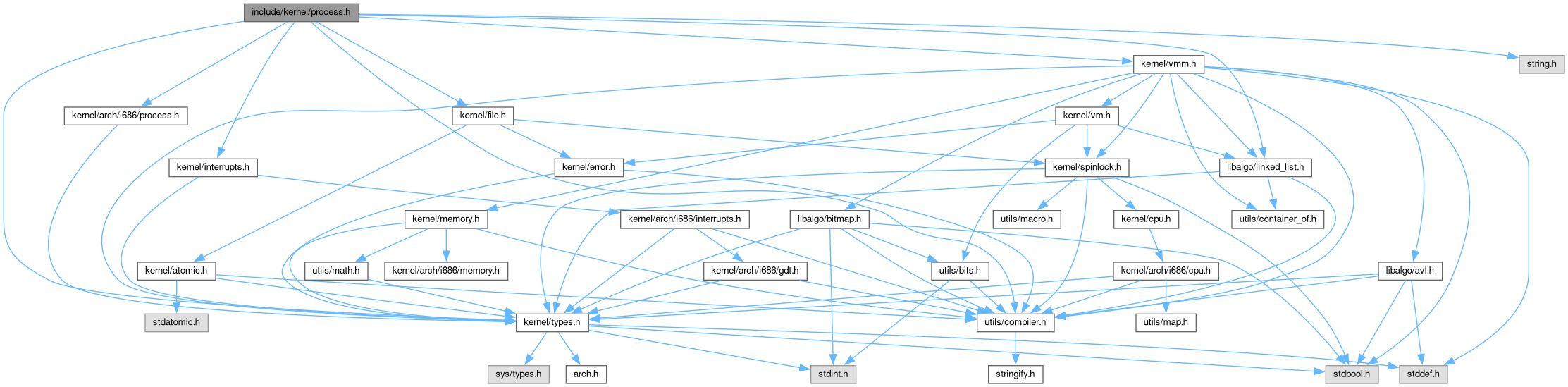
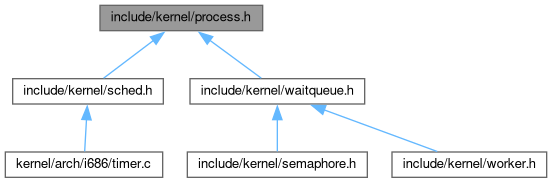
Go to the source code of this file.
Data Structures | |
| struct | process |
| A single process. More... | |
| struct | thread |
| A single thread. More... | |
Macros | |
| #define | PROCESS_NAME_MAX_LEN 32U |
| The max length of a process's name. | |
| #define | PROCESS_FD_COUNT 32 |
| Maximum number of files that one process can have open at any one time. | |
Typedefs | |
| typedef void(* | thread_entry_t) (void *data) |
| A function used as an entry point when creating a new thread. More... | |
Enumerations | |
| enum | thread_state { SCHED_RUNNING , SCHED_WAITING , SCHED_ZOMBIE , SCHED_KILLED } |
| The different states a thread can be in. More... | |
| enum | thread_flags { THREAD_KERNEL = BIT(0) , THREAD_RESCHED = BIT(1) } |
Functions | |
| static ALWAYS_INLINE bool | thread_is_initial (thread_t *thread) |
| The initial thread is the thread created along with the process. More... | |
| static void | thread_set_stack_pointer (struct thread *thread, void *stack) |
| Set the thread's current stack pointer. | |
| static void * | thread_get_stack_pointer (struct thread *thread) |
| Get the thread's current stack pointer. | |
| static void | thread_set_base_pointer (struct thread *thread, void *ptr) |
| Set the thread's current base pointer. | |
| static void * | thread_get_base_pointer (struct thread *thread) |
| Get the thread's current base pointer. | |
| static void | thread_set_interrupt_frame (thread_t *thread, const struct interrupt_frame *frame) |
| Set a thread's curent interrupt frame. | |
| static struct interrupt_frame * | thread_get_interrupt_frame (struct thread *thread) |
| Get a thread's current interrupt frame. | |
| static void | thread_set_kernel_stack (struct thread *thread, void *stack) |
| Set the thread's kernel stack bottom address. | |
| static void * | thread_get_kernel_stack_top (const struct thread *thread) |
| Get the thread's kernel stack top address. | |
| static void * | thread_get_kernel_stack (const struct thread *thread) |
| Get the thread's kernel stack bottom address. | |
| static void | thread_set_user_stack (struct thread *thread, void *stack) |
| Set the thread's user stack bottom address. | |
| static void * | thread_get_user_stack_top (const struct thread *thread) |
| Get the thread's user stack top address. | |
| static void * | thread_get_user_stack (const struct thread *thread) |
| Get the thread's user stack bottom address. | |
| static void * | thread_get_interrupt_return_address (const struct thread *thread) |
| Read the thread's return address when exiting the current interrupt context. | |
| void | process_init_kernel_process (void) |
| Initialize the kernel process's address space. More... | |
| void | process_kill (struct process *process, uint16_t status) |
| Kill a process. | |
| int | process_register_file (struct process *, struct file *) |
| Register an open file inside the process's open file descriptor table. More... | |
| error_t | process_unregister_file (struct process *, int fd) |
| Remove an open file from the process's open file descriptor table. | |
| struct file * | process_file_get (struct process *, int fd) |
| static void | process_file_put (struct process *process, struct file *file) |
| Release a file description retreived using process_file_get(). | |
| struct thread * | process_execute_in_userland (const char *exec_path) |
| Run an executable. More... | |
| struct process * | process_find_by_pid (pid_t pid) |
| Find an alive process by its PID. | |
| bool | thread_switch (thread_t *) |
| Switch the currently running thread. More... | |
| thread_t * | thread_spawn (struct process *, thread_entry_t, void *data, void *esp, void *ebp, u32 flags) |
| Create and initialize a new thread. More... | |
| NO_RETURN void | thread_jump_to_userland (void *stack_pointer, void *base_pointer, thread_entry_t, void *) |
| Start executing code in userland. More... | |
| void | thread_set_mmu (struct thread *thread, paddr_t mmu) |
| Set the MMU address saved inside the thread's structure. More... | |
| void | thread_kill (thread_t *) |
| Effectively kill a thread. More... | |
| struct thread * | thread_fork (struct thread *, thread_entry_t, void *) |
| Create a new fork of the given thread. More... | |
| void | thread_deliver_pending_signal (struct thread *thread) |
| Try and deliver the first non-blocked pending signal. More... | |
| struct thread * | thread_find_by_tid (pid_t tid) |
| Find an alive thread by its TID. | |
Variables | |
| struct process | kernel_process |
| Process used when starting up the kernel. More... | |
| struct process * | init_process |
| The init process is the very first executed userland process. More... | |
| thread_t * | current |
| The currently running thread. | |
Detailed Description
This file defines the data structures and functions for managing processes and threads in a multithreading model.
A process is an instance of a program that is being executed by one or more threads. Each process has its own unique address space, which means that it has its own virtual memory space that is separate from other processes. This allows each process to have its own private memory space, which is not accessible to other processes. A process also has its own set of system resources, such as open files descriptors.
A thread is an execution context that is created within a process. Threads within the same process share the same address space. They do not share the same execution context (registers, stack).
Both processes and threads are identified using a unique id: PID and TID. Threads do not exist without a containing process, and processes are forced to always contain at least one alive thread.
The file provides functions for creating and killing processes, creating and killing threads, as well as switching between them.